By WBro Jeff Johnston Kinistino Lodge #1
The regius poem is one of the oldest documents that discuss masonry, specifically it is the oldest of the documents referred to as “The Old Charges”, essentially the founding documents Masonry Guilds, and eventually Grand Lodges of Freemasonry in England. The Regius Poem was written at a time when masonry generally existed purely as operative masonry, some believe that over time there was a transition. As Operative mason guilds began to dwindle in members they started to accept non operative masons into the lodge and eventually the speculative masons not only outnumbered but completely replaced the operative masons. This may or may not have merit. The time between the writing of the two oldest of the old charges and the next two is considerable, and while there were certainly documents between the time periods they would be lost to history and will likely never be recovered.
The Regius poem, also known as the Halliwell Manuscript, had a fairly obscure history and was donated to The British Museum in 1757. When it was donated it was noted that it had been mis-catalogued as “A Poem of Moral Duties” in 1737. Once there it languished in relative obscurity until in 1840 James Halliwell-Phillipps published a paper called “The early History of Freemasonry in England”. James Halliwell-Pillipps was not a Freemason himself, but upon reading the Poem he recognized the ties to early masonry.
Dating of the poem itself has been a matter of considerable discussion, in the end it appears to be sometime between 1390-1425. The most recent attempts to date it date it to 1425, the reason for this is Henry the 6th creating a statute which banned the meeting of masons in an attempt to quash the formation of guilds. It is believed that the poem was written as a response and as a way to legitimize the meeting of masons and to create secrecy around the meeting of Masons. Some credit the attempts by the English Government to suppress the guilds as one of the primary pressures which ended up creating the concept of Freemasonry.
The Regius Poem is generally considered the template on which all future constitutions were written. It contains a preamble, which discusses the history of masonry and how it came to England, and 15 articles laying out the expected behaviour of a mason, it also describes the importance of annual assemblies of masons, and finishes with a prayer similar to the obligations we take as masons. Interestingly this prayer at the end is the earliest example of the phrase “so mote it be” being associated with masonry.
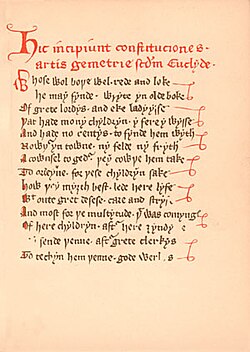
I won’t read the entire 64 page manuscript, but here is the opening section of the poem focusing on the history of how masonry came to England.
Here begin the constitutions of the art of Geometry according to Euclid.
Whoever will both well read and look
He may find written in old book
Of great lords and also ladies,
That had many children together, certainly;
And had no income to keep them with,
Neither in town nor field nor enclosed wood;
A council together they could them take,
To ordain for these children’s sake,
How they might best lead their life
Without great disease, care and strife;
And most for the multitude that was coming
Of their children after great clerks,
To teach them then good works;
And pray we them, for our Lord’s sake.
To our children some work to make,
That they might get their living thereby,
Both well and honestly full securely
In that time, through good geometry,
This honest craft of good masonry
Was ordained and made in this manner,
Counterfeited of these clerks together;
At these lord’s prayers they counterfeited geometry,
And gave it the name of masonry,
For the most honest craft of all.
These lords’ children thereto did fall,
To learn of him the craft of geometry,
The which he made full curiously;
Through fathers’ prayers and mothers’ also,
This honest craft he put them to.
He learned best, and was of honesty,
And passed his fellows in curiosity,
If in that craft he did him pass,
He should have more worship than the less,
This great clerk’s name was Euclid,
His name it spread full wonder wide.
Yet this great clerk ordained he
To him that was higher in this degree,
That he should teach the simplest of wit
In that honest craft to be perfect;
And so each one shall teach the other,
And love together as sister and brother.
Futhermore yet that ordained he,
Master called so should he be;
So that he were most worshipped,
Then should he be so called;
But masons should never one another call,
Within the craft amongst them all,
Neither subject nor servant, my dear brother,
Though he be not so perfect as is another;
Each shall call other fellows by friendship,
Because they come of ladies’ birth.
On this manner, through good wit of geometry,
Began first the craft of masonry;
The clerk Euclid on this wise it found,
This craft of geometry in Egypt land.
In Egypt he taught it full wide,
In divers lands on every side;
Many years afterwards, I understand,
Ere that the craft came into this land.
This craft came into England, as I you say,
In time of good King Athelstane’s day;
He made then both hall and even bower,
And high temples of great honour,
To disport him in both day and night,
And to worship his God with all his might.
This good lord loved this craft full well,
And purposed to strengthen it every part,
For divers faults that in the craft he found;
He sent about into the land
After all the masons of the craft,
To come to him full even straight,
For to amend these defaults all
By good counsel, if it might fall.
An assembly then could let make
Of divers lords in their state,
Dukes, earls, and barons also,
Knights, squires and many more,
And the great burgesses of that city,
They were there all in their degree;
There were there each one always,
To ordain for these masons’ estate,
There they sought by their wit,
How they might govern it;
Fifteen articles they there sought,
And fifteen points there they wrought,
The poem then goes on to lay out the 15 points or articles which I won’t dive into. Another interesting section is the laying out of the seven Sciences:
Many years after, the good clerk Euclid
Taught the craft of geometry full wonder wide,
So he did that other time also,
Of divers crafts many more.
Through high grace of Christ in heaven,
He commenced in the sciences seven;
Grammar is the first science I know,
Dialect the second, so I have I bliss,
Rhetoric the third without doubt,
Music is the fourth, as I you say,
Astronomy is the fifth, by my snout,
Arithmetic the sixth, without doubt,
Geometry the seventh maketh an end,
For he is both meek and courteous,
Grammar forsooth is the root,
Whoever will learn on the book;
But art passeth in his degree,
As the fruit doth the root of the tree;
Rhetoric measureth with ornate speech among,
And music it is a sweet song;
Astronomy numbereth, my dear brother,
Arithmetic sheweth one thing that is another,
Geometry the seventh science it is,
That can separate falsehood from truth,
I know These be the sciences seven,
Who useth them well he may have heaven.
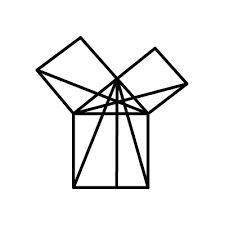
It should be noted there is no mention at all of our familiar Hiramic legends that are an allegorical key to modern freemasonry. So far as I know there is no evidence to suggest that the Hiramic legend had any association with masonry at that time, it could be that it was, but not written down, much the same as modern freemasons don’t necessarily mention the Hiramic legends in our constitutions. The Euclidian link however does echo down through the ages. The symbol we use in our lodge for a past master is an illustration of the 47th proposition of Euclid suspended beneath a square. The 47th proposition demonstrates proof of Pythagoras’ theorem showing that the square of the two shorter sides of a triangle always equals the square of the longer side. While Pythagoras demonstrated the effect, it was Euclid who provided the proof in a visible and easy way to understand. We use it as a symbol of a Past Master to denote his mastery of the craft. As the proposition is a demonstration of the stability of Geometry, so the symbol is a demonstration of a past master’s role in maintaining the stability of a lodge.
The Regius Poem predates Speculative or Freemasonry as we know it today, but it’s an important cornerstone on which the foundation of our brotherhood was laid. A template, or rough ashlar, if you will. That template was worked upon to smooth out and form the smooth ashlar that would be the cornerstone of our fraternity, the Constitution of our own Grand Lodge. Knowing where we come from is important in understanding our role as Masons and why we meet as we do. Reading the old charges is a great way to understand our history as a fraternity. The original poem was written in Middle English so can be a tad difficult to read, but there are many translations available. If anyone would like to read a version I can provide a source for such a translation, or even a source for the original Middle English version if you are brave enough. A translation and the original will also be uploaded to our website as soon as possible.